
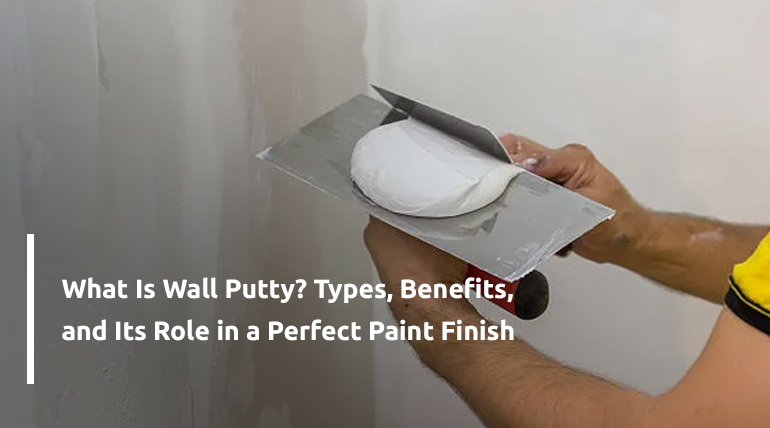
Walk into any freshly painted room and run your hand along the wall. If it feels perfectly even, if the colour looks rich and uniform, and if there isn’t a single hairline crack peeking through the paint, chances are a quality wall putty was applied before the paint ever touched the surface. It’s one of the most important yet often overlooked steps in wall finishing, playing a critical role in achieving a smooth, durable, and professional-looking paint finish.
So, what is wall putty exactly?
Wall putty is a cement or polymer-based finishing material applied to walls and ceilings after plastering and before painting. Its primary purpose is to fill minor cracks, pores, and surface imperfections, creating a smooth and even base for primer and paint. Without putty, paint can get absorbed unevenly into the plaster, resulting in patchy coverage, reduced durability, and an increased risk of peeling or cracking over time.
In this blog, we’ll explore the major types of wall putty, the benefits they offer, and how choosing the right wall putty can help create walls that look beautiful and stay protected for years.
Understanding the Primary Types of Wall Putty for Your Home
Wall putty is available in different formulations designed to meet different application needs. The two most commonly used types are:
White Cement-Based Wall Putty
White cement-based wall putty is the preferred choice for most residential and commercial projects. It is formulated using white cement, minerals, and performance-enhancing polymers that provide excellent adhesion, durability, and smoothness.
It helps fill surface imperfections, create an even substrate for paint, and improves the overall appearance of the finished wall. Its bright white base enhances paint shades and helps colours appear richer and more uniform. Due to its strong bonding properties, white cement-based putty also minimizes the chances of flaking, cracking, and paint failure over time.
Acrylic Wall Putty
Acrylic wall putty is a water-based, ready-to-use formulation that is primarily used for interior walls. Since it comes pre-mixed, it simplifies application and helps achieve a smooth finish with minimal preparation.
Acrylic putty is commonly used in renovation and decorative projects where a refined surface finish is desired. It delivers good adhesion and helps create an aesthetically pleasing base before painting.
Selecting the right putty depends on factors such as wall condition, desired finish, moisture exposure, and project requirements.
Choosing the Right Wall Putty for Your Walls
Choosing the right wall putty depends on the condition of your walls, the type of finish you’re aiming for, and the performance requirements of the space.
● For everyday interior walls, Homesure Wall Putty provides a smooth, durable base for paint while helping improve adhesion and finish quality.
● For premium interiors and moisture-prone areas, Homesure Premium Putty offers enhanced smoothness along with water-resistant properties, making it suitable for spaces where durability and aesthetics are equally important.
● For vibrant paint colours, Homesure Colour Putty creates a coloured base coat that can improve paint coverage and help colours appear brighter, richer, and more uniform.
● For uneven or rough plastered surfaces, Homesure Coarse Putty helps level surface irregularities and prepare the wall for the final finishing coat.
By selecting the right putty based on your wall condition and finishing needs, you can improve paint performance, reduce maintenance, and ensure a longer-lasting finish.
The Structural and Aesthetic Benefits of Wall Putty
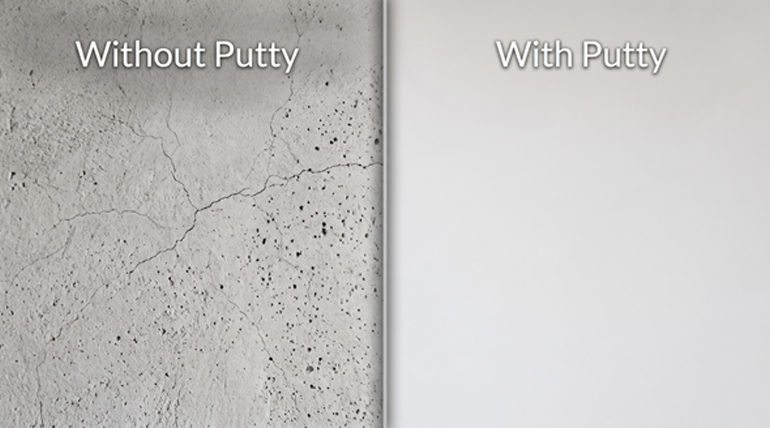
Beyond preparing a wall for paint, wall putty provides several practical benefits that contribute to both the appearance and longevity of painted surfaces.
Levels Out Surface Imperfections
Freshly plastered walls are rarely perfectly smooth. Wall putty fills minor undulations, pores, and hairline cracks, creating an even surface that allows paint to sit uniformly across the wall. This is especially important in areas with strong natural or artificial lighting, where even small imperfections can become highly visible.
Improves Paint Adhesion
One of the key functions of white cement based putty is to strengthen the bond between the wall surface and the paint. Better adhesion reduces the likelihood of paint peeling, flaking, or blistering, helping the finish remain intact for longer.
Reduces Paint Consumption
Plastered walls are naturally porous and can absorb paint unevenly. Wall putty seals these pores and reduces surface absorption, allowing paint to spread more evenly and efficiently. This often results in better coverage with fewer coats, helping reduce paint consumption and overall project costs.
Enhances Paint Appearance
A smooth, uniform base improves the final appearance of painted walls by enabling colours to develop their true richness and depth. It also contributes to a more consistent finish with improved colour vibrancy and sheen.
Improves Durability
Wall putty adds an additional protective layer to the wall surface, helping it withstand everyday wear and tear. It contributes to a stronger paint system and supports longer-lasting wall finishes.
Final Thoughts
Wall putty may remain hidden beneath the paint, but its contribution to the final finish is impossible to ignore. From improving paint adhesion and reducing paint consumption to creating smoother, more attractive walls, it forms the foundation of any successful painting project.
Whether you’re building a new home or renovating an existing space, selecting the right wall putty can significantly improve the beauty and longevity of your walls. With solutions ranging from Homesure Wall Putty and Colour Putty to Premium Putty and Coarse Putty, homeowners can choose a product tailored to their specific needs and achieve a flawless finish that lasts.