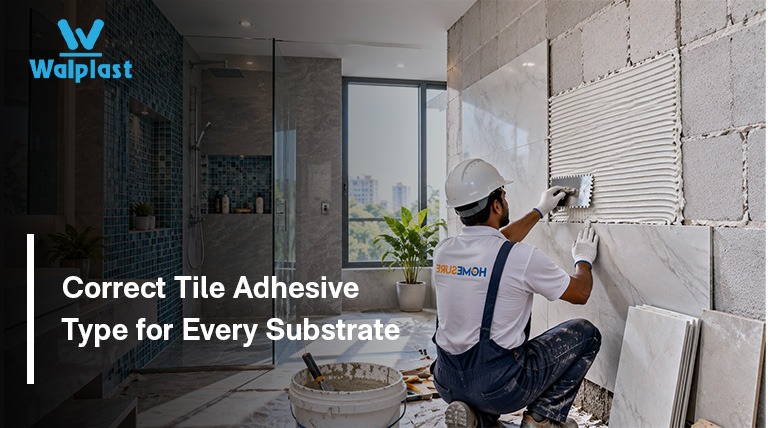
Indian construction has changed faster in the last decade than in the previous five. Red brick and plastered masonry walls are giving way to AAC (Autoclaved Aerated Concrete) block partitions and fly ash brick structures. Floor finishes that were once 300×300 mm ceramic have moved to 600×600 mm and 1200×1200 mm vitrified slabs. Glass mosaics, natural marble, and imported stone now appear in mid-range residential projects, not just luxury interiors.
Sand-cement mortar cannot handle this shift. It bonds adequately to porous ceramics on absorbent masonry, but it fails on low-porosity vitrified tiles, on smooth-faced AAC blocks, and on any substrate exposed to India’s monsoon cycles or coastal humidity.
Hollow sounds under floor tiles, grout cracks at corners, and full tile debonding in wet areas and external applications within one or two monsoon seasons are predictable failure modes. In almost every case, the root cause is the same: the adhesive was chosen for price or availability rather than substrate compatibility and application environment.
The Bureau of Indian Standards’ IS 15477:2019 specification for ceramic tile adhesives gives us a way to fix that based on performance. It classifies adhesives by tested properties: tensile adhesion, shear adhesion, open time, deformability, and slip resistance.
This article maps every common Indian substrate and tile combination to the correct IS 15477:2019 type, and identifies the HomeSureTileEx products that fulfil each classification. Verify the exact type codes against the IS 15477:2019 BIS document and product TDS before specification.
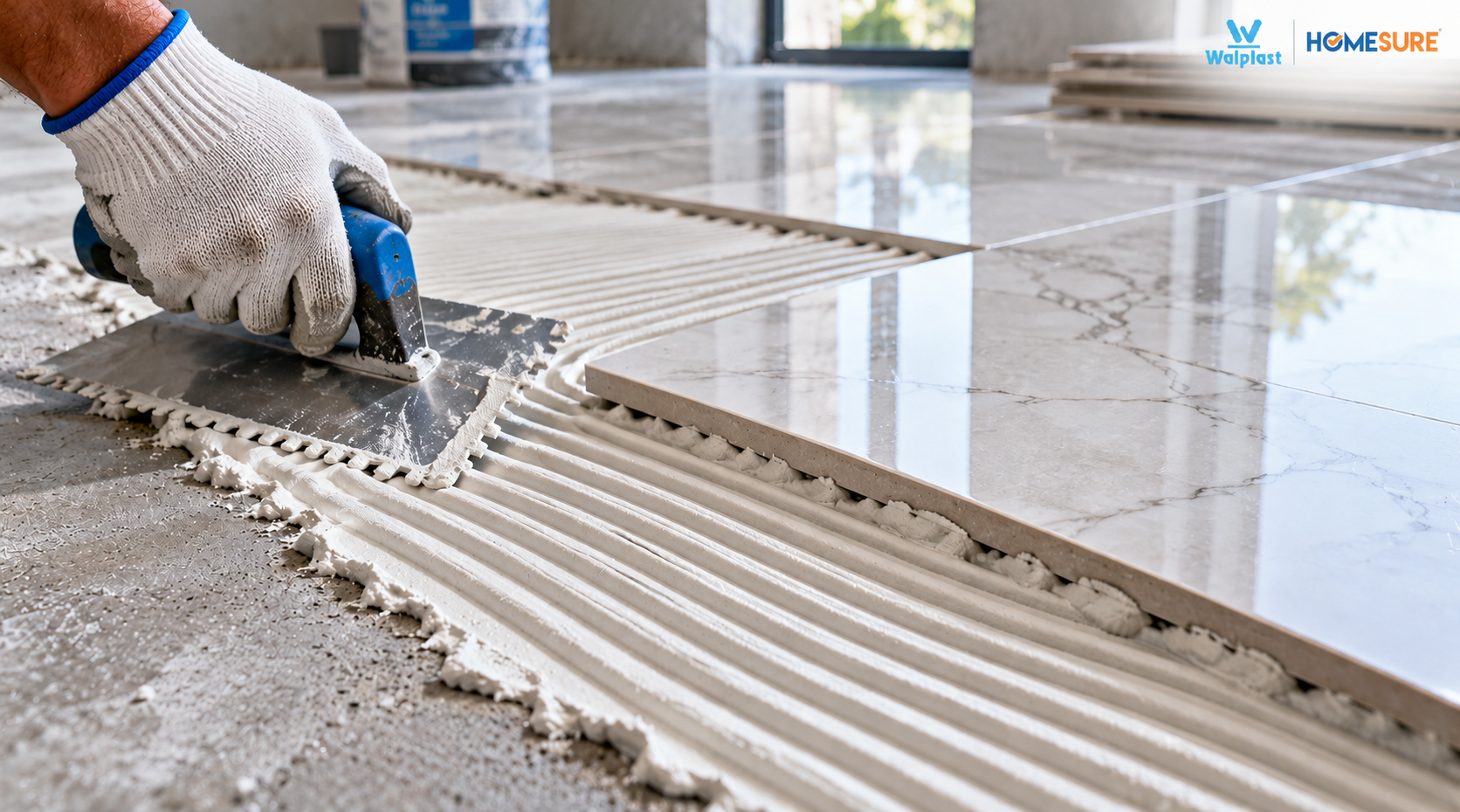
Understanding Tile Adhesive Grades Under IS 15477:2019
IS 15477:2019 classifies adhesives by performance, not by composition. If two products from different companies meet the same testing standards, they can both be given the same classification. This means the IS type on a product’s TDS is an objective standard, not a marketing label. This makes the standard useful for specification: it provides a common language across brands and suppliers.
The key properties BIS tests under IS 15477:2019 are:
● Tensile adhesion strength: The bond force pulling perpendicular to the surface
● Shear adhesion strength: Resistance to the tile sliding laterally along the bond plane
● Open time: How long the adhesive stays workable after you spread it
● Adjustment time: How long you can reposition a tile after setting it
● Slip (S sub-class): Whether the adhesive holds tiles in place on vertical surfaces without sliding
● Deformability (S1/S2 sub-class): How much the cured adhesive can flex before the bond fails
These properties define five types. Each type has a minimum performance level. A product can perform better than its declared classification, and the TDS shows exactly what has been tested.
Type 1: Normal Cementitious Tile Adhesives
The baseline classification under IS 15477:2019. Type 1 adhesives for tiles meet a standard tensile adhesion threshold. They are designed for internal use in dry areas. These adhesives work on traditional absorbent substrates. Examples include plastered red brick masonry, cement-sand render on concrete. The surface must be porous enough for mechanical keying. Standard ceramic wall tiles and floor tiles typically have water absorption more than3%. These tiles bond well with Type 1 products. Do not use Type 1 on vitrified tiles, polished stone, gypsum plaster surfaces, or any metal/ drywall substrate without a primer, as these surfaces lack the absorption needed for adequate mechanical bonding.
HomeSureTileEx Products: EX 11 Ceramic Expert
Type 2: Improved Cementitious Tile Adhesive
Type 2 raises bond strength. It also extends open and adjustment times. These properties are important when working with low-porosity tile materials. Vitrified tiles (water absorption typically below 0.5%), polished natural stone, and glass tiles do not absorb the adhesive the way ceramic does, so the adhesive itself must work harder. Type 2 formulations compensate for that. In Indian residential construction, Type 2 is now the practical minimum for any vitrified tile installation, and should also be used on gypsum plaster walls, which are increasingly common in apartments and are more sensitive substrates than cement-plastered brick. Type 2 suits internal walls and external floors in dry to moderately damp conditions.
HomeSureTileEx Products: EX-22 Vitrified Expert | EX-G33 Vitrified & Stone Expert | EX-33 Stone & Glass Expert
Type 3: Cementitious Adhesive with Improved Water Resistance
Type 3 is the first classification designed for Indian climate realities. These adhesives undergo performance testing. They are evaluated under sustained moisture exposure. For external grades, they are also tested for thermal and UV cycling. This matters because Indian exterior tile adhesive face harsh conditions year-round. In coastal cities like Mumbai, Chennai, and Kochi, where ambient humidity rarely drops below 70% even in winter, wet-area adhesives must maintain bond strength across monsoon and dry seasons. Type 3 is the minimum for bathroom floors and walls, kitchen wet areas, external wall cladding, and any application that sees direct water or rain. Check the product TDS for suitability on AAC block façades, now common in mid-rise residential buildings, for external applications.
HomeSureTileEx Products: EX 344 W | EX-44 External Expert
Type 4: Highly Deformable Cementitious Adhesive
Type 4 adhesives have a declared deformability classification, meaning the cured bond can flex to accommodate substrate movement without failing. This matters in three common Indian scenarios: large-format vitrified tiles (600×600 mm and above) on concrete floor slabs that experience thermal expansion; rooftop and terrace tiling, where the temperature differential between night and midday can exceed 30°C in north Indian summers; and tiling on elevated floor systems or deflecting slabs in commercial and high-rise projects. The polymer content in Type 4 also provides extended open time, which is essential when laying heavy stone formats where adjustments take longer.
HomeSureTileEx Products: EX 55 All Tile Expert | EX 456 W
Type 5: Reactive Resin Tile Adhesive
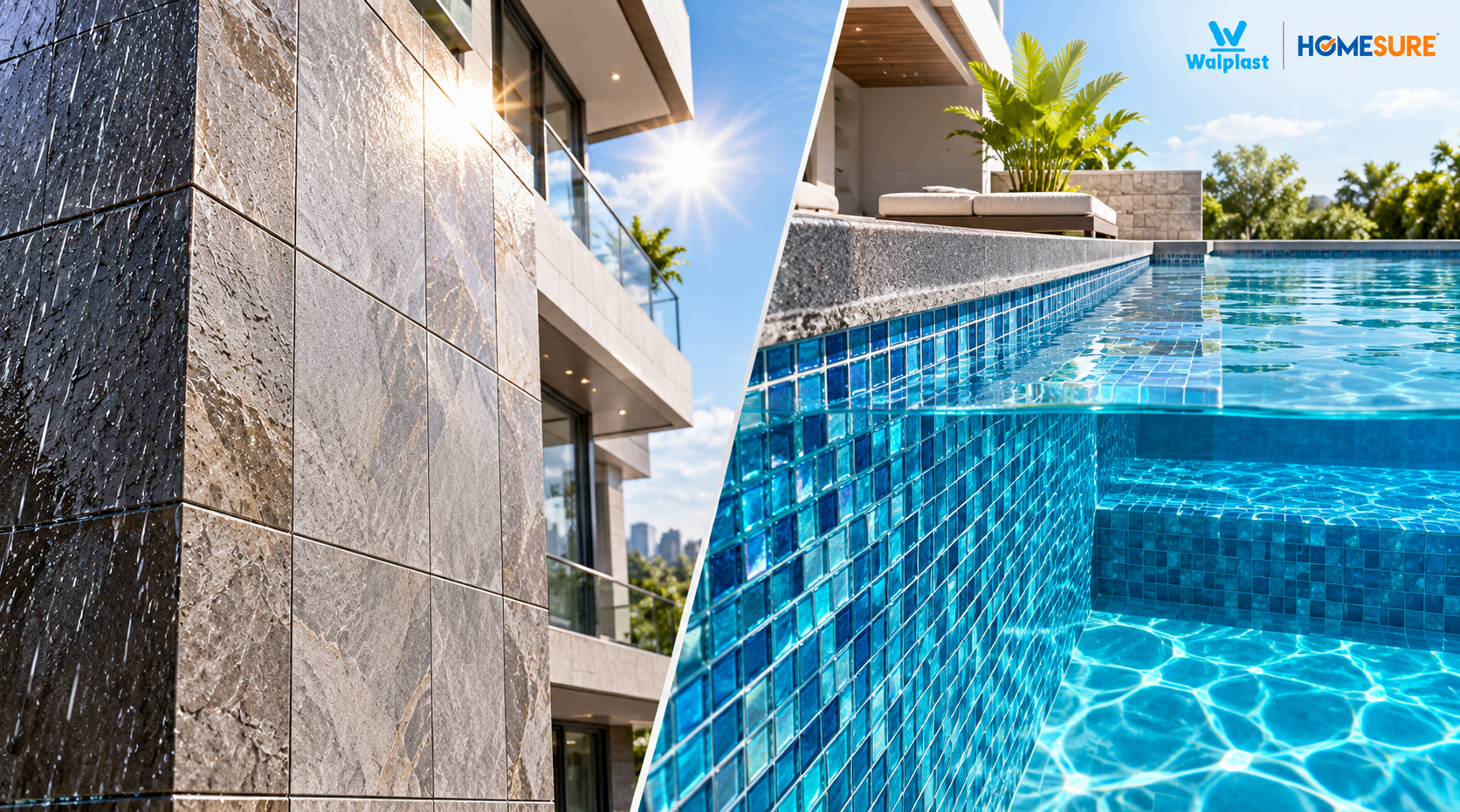
Type 5 covers epoxy or polyurethane-based reactive resin systems where cement-based adhesives fail. These products deliver chemical resistance, near-zero water permeability when cured, and bond strengths no cementitious adhesive can match. Type 5 is used in India for continuously submerged surfaces (swimming pools, water features, overhead tank bases), food processing and pharmaceutical facility floors subject to chemical cleaning agents, and non-porous substrates (glass, metal, epoxy screed) where cement bonding cannot form. Application requires strict control of the water-to-powder ratio and is sensitive to ambient temperature; follow the TDS closely.
HomeSureTileEx Products: EX 566 PU Based Tile Adhesive
Subclassifications to check in the TDS: IS 15477:2019 allows slip resistance (S: holds tiles vertically without sliding), fast setting (F), and extended open time within each type. For deformability, check for S1 (deformable) or S2 (highly deformable) on the TDS. These suffixes are often more important than the base type number for the actual installation condition.
Choosing Adhesives for Tile Applications by Performance Grade
In practice, the type number is a starting point. How well an adhesive’s tested properties match the installation’s tile porosity, substrate behavior, climate, and use conditions determines its longevity in an Indian building.
Consider three typical Indian scenarios:
● An internal bathroom wall in a Bangalore apartment tiled with 600×300 mm vitrified tiles on a gypsum-plastered AAC block wall: the low tile porosity and the sensitive substrate together push the minimum to Type 4, with the S sub-class if the contractor is applying tiles vertically.
● A south-facing terrace in Chennai with 600×600 mm vitrified tiles on a concrete slab requires a minimum of Type 4 due to thermal cycling, monsoon water exposure, and the large tile format, with deformability as the criterion.
● A swimming pool surround in a Mumbai residential complex using glass mosaic: continuous water contact and a non-porous tile surface require Type 5. No cementitious alternative will hold under those conditions long term.
This is why specifying a certified tile adhesive supplier matters: the product’s BIS certification and TDS provide tested evidence that it meets the threshold you need, not just a label claiming it does. The BIS ISI Mark on outdoor tile adhesive packaging indicates that it has been tested and certified against IS 15477:2019. A product without the ISI Mark has not been independently verified, regardless of what the label states.
Substrate × Tile-Type Adhesive Grade Reference
Use the table below to identify the minimum IS 15477:2019 type for your application. Where a range appears, use the higher type for large-format tiles (above 600×600 mm), flexible or deflecting substrates, and coastal or high-humidity locations.
Application / Substrate | Ceramic/ Porcelain | Vitrified | Natural Stone | Glass Mosaic |
Internal wall: cementitious (dry area) | Type 1 | Type 2 | Type 2 | Type 2 |
Internal wall: Gypsum plaster | Type 4 | Type 4 | Type 4 | Type 4 |
Internal floor: Dry area (concrete/screed) | Type 1 | Type 2 | Type 2 | — |
Internal Wet areas: bathroom/kitchen floor & wall | Type 2 | Type 2 | Type 2 | Type 3 |
External wall: Façade | Type 3 | Type 3–4 | Type 4 | Type 4 |
Terrace / rooftop floor (thermal cycling) | Type 3 | Type 4 | Type 4 | — |
External floor: Heavy foot traffic | Type 3 | Type 4 | Type 4 | — |
Submerged: Swimming pool / water features | — | Type 3/4 | Type 3/4 | Type 3 /4 |
Chemically exposed: Industrial / F&B / pharma floors | — | Type 5 | Type 5 | Type 5 |
Minimum recommended type. Upgrade one type for large formats (>600×600 mm), coastal / high-humidity locations, and flexible or deflecting substrates. Always read the product TDS before installation.
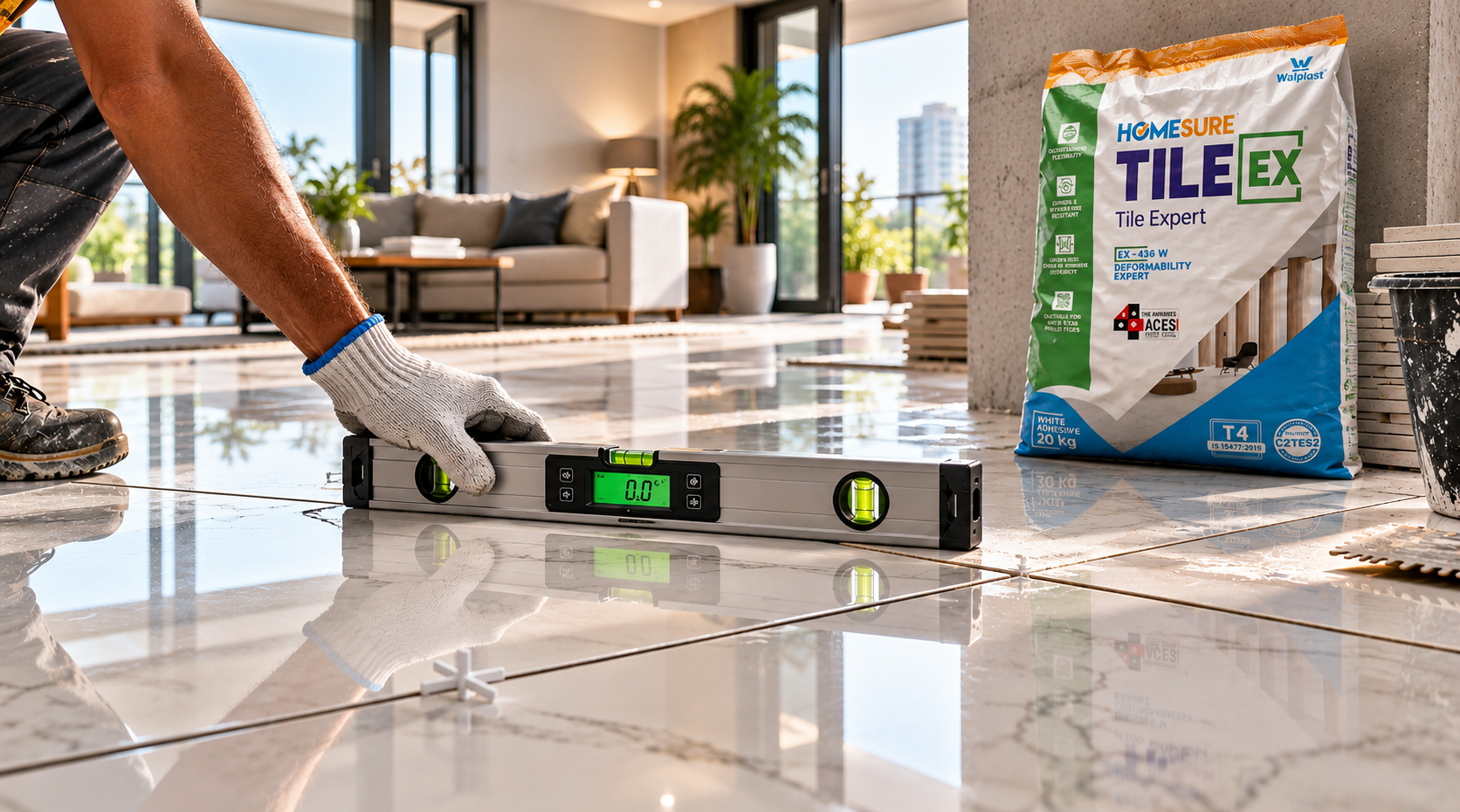
Selecting the Right Tile Adhesive Grade
Follow these steps in order. Each one narrows the choice. By step 6, the correct IS type and the correct TileEx product will be clear.
Step 1: Identify the tile material and water absorption.
Ceramic (>6% absorption) needs less adhesive performance than vitrified or porcelain (<0.5%) or glass/stone (near zero). The lower the tile’s absorption, the higher the minimum adhesive type.
Step 2: Identify the substrate and its surface condition.
Substrates include cement plaster, concrete slabs, or existing tiles. Even vetrified tiles usually require a minimum Type 2.
Step 3: Determine the application environment.
Internal dry, internal wet, external, or submerged. This single factor eliminates more options than any other step. A coastal location or a high-rainfall zone (most of peninsular India) should push wet-area and external selections one type higher than the minimum.
Step 4: Check whether vertical slip resistance is required.
All wall tile applications and tile adhesive installation need an Adhesive for Tiles with the S sub-class declared on the TDS, confirming it holds tiles vertically without sliding during the open time window.
Step 5: Check whether deformability is required.
Terraces, rooftops, large-format tiles on slabs, and any elevated floor system require deformability. Look for S1 or S2 declared on the TDS.
Step 6: Match your requirements to the declared IS 15477:2019 classification.
The product must meet or exceed the minimum type. Make sure that the sub-classes (S, E, F, S1/S2) are shown on the BIS certification or TDS, not just on the marketing label.
Remember: Adhesive selection is a technical decision, not a purchasing one. Choosing by price, brand name, or colour without checking the IS classification is the single most common cause of tile debonding on Indian construction sites.
HomeSureTileEx Range
The TileEx product line covers all five IS 15477:2019 types.
● Type 1 (EX 11 Ceramic Expert)
● Type 2 (EX-22 Vitrified Expert, EX-G33 Vitrified & Stone Expert, EX-33 Stone & Glass Expert)
● Type 3 (EX 344 W, EX-44 External Expert)
● Type 4 (EX 55 All Tile Expert, EX 456 W)
● Type 5 (EX 566 PU Based Tile Adhesive)
One certified supplier, all application types.
Final Guidance on Selecting Certified Tile Adhesives
While IS 15477:2019 does not automate adhesive selection, it does hold people responsible. The standard defines what a product must demonstrate under test to carry a given classification. That changes the question from “which brand should I buy?” to “what does this tile adhesive installation require?” This is the right question for any project, whether it’s a Pune two-bedroom apartment bathroom or a Hyderabad commercial plaza.
Indian tile installations often fail for predictable reasons, such as debonding under the first monsoon, hollow floors after 18 months, and grout cracks on external walls. They are the predictable result of using a Type 1 or Type 2 adhesive where Type 3 or 4 was required, or a cementitious product where a reactive resin was the only compliant choice. Working through the framework in this article would have caught every one of those mismatches before the first tile was laid.
Before installation, use the substrate table to check the product’s IS 15477:2019 type against the project’s requirements, confirm sub-class requirements based on structural and environmental conditions, check the packaging for the BIS ISI Mark, and read the TDS. Not paperwork; the TDS specifies what the adhesive can and cannot do.
HomeSure TileEx is built as an application-focused range, with each product at a specific IS 15477:2019 type. Explore the full range at Homesure TileEx for complete TDS documents, IS classifications, and substrate-specific guidance.
Every TileEx product carries a declared IS 15477:2019 classification and BIS ISI Mark. Visit Homesure TileEx for complete technical data sheets and substrate-specific guidance.