

Tiles have evolved dramatically over the last two decades. Modern homes, commercial buildings, hospitals, hotels, shopping centres, and infrastructure projects increasingly use vitrified tiles, porcelain tiles, natural stone, and large-format tiles because they offer superior durability, aesthetics, and ease of maintenance. While tile technology has advanced significantly, installation methods have not always kept pace.
For many years, traditional sand-cement mortar was the preferred method for fixing tiles. It performed reasonably well with older ceramic tiles, which had a porous surface that allowed cement to develop a mechanical bond. However, today’s high-density, low-porosity tiles demand a far stronger and more reliable bonding solution.
This is where tile adhesives have transformed the construction industry. Designed using advanced cementitious binders, polymers, and performance-enhancing additives, tile adhesives provide superior bonding strength, flexibility, and durability compared to conventional cement mortar. They have become the preferred choice for professional tile installations because they help minimise failures, improve installation efficiency, and ensure long-term performance.
Understanding why traditional cement falls short—and why tile adhesives have become the industry standard—can help homeowners, architects, contractors, and builders make informed decisions for durable tile installations.
Why Traditional Cement Mortar Is No Longer Suitable for Modern Tiles
Traditional sand-cement mortar was developed for a generation of tiles that behaved very differently from those used today. While it remains suitable for certain masonry applications, it struggles to meet the performance requirements of modern flooring systems.
1. Modern Tiles Have Very Low Porosity
Older ceramic tiles contained microscopic pores that allowed cement mortar to penetrate the tile surface during installation. Once the cement hardened, it created a mechanical bond that helped hold the tile in place.
Modern vitrified tiles are manufactured under extremely high pressure and temperature, resulting in a dense, almost glass-like structure. Because these tiles absorb very little water, cement mortar cannot effectively penetrate or grip their surface.
As a result, the bond formed by conventional cement is often weaker than required for long-term performance.
2. Weak Bonding Leads to Tile Debonding
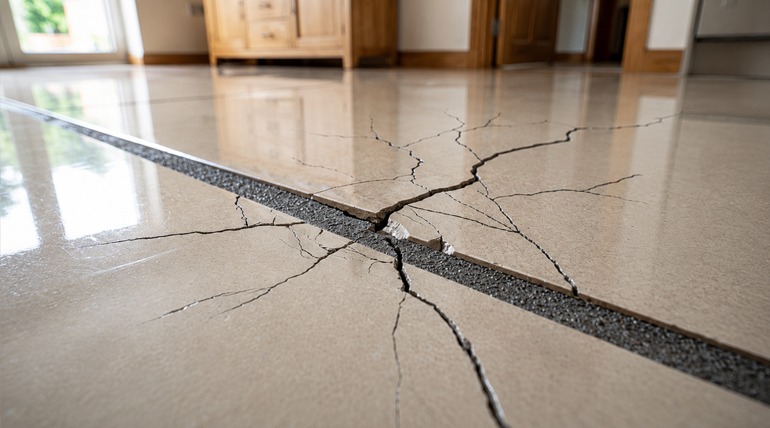
One of the most common tile installation failures is debonding, where tiles gradually separate from the substrate. This usually begins with hollow sounds beneath the tiles before progressing to loose, cracked, or completely detached tiles.
Several factors contribute to this problem:
• Poor adhesion between cement and low-porosity tiles
• Shrinkage during cement curing
• Daily thermal expansion and contraction
• Structural movement
• Heavy foot traffic
• Moisture penetration
Repairing debonded tiles can be expensive because affected areas often need to be removed and reinstalled completely.
3. Traditional Cement Has no Flexibility
Buildings naturally move throughout their lifetime. Temperature changes, structural settlement, vibrations, and daily loading cause minor movements in floors and walls.
Conventional cement mortar is rigid and brittle. It cannot effectively absorb these movements, leading to stress within the tiled surface. Over time, this stress may cause cracked grout joints, hollow tiles, or bond failure.
How Tile Adhesives Solve These Challenges
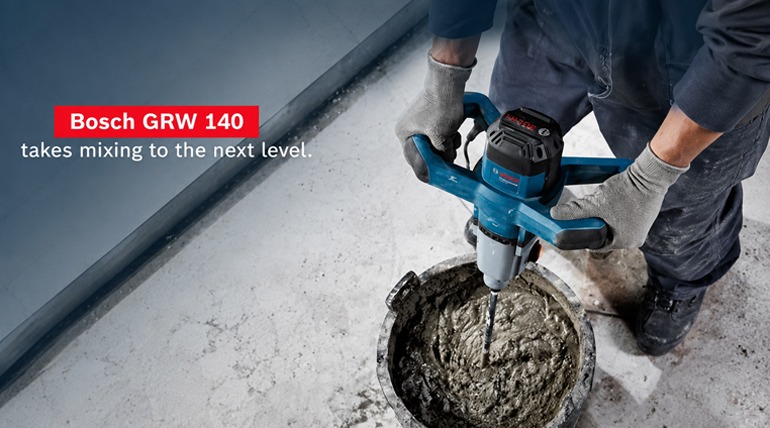
Tile adhesives are engineered specifically for modern tile installation requirements. Unlike traditional cement mortar, they create both mechanical and chemical bonding with the tile and substrate, resulting in a much stronger and more durable installation.
Superior Bond Strength
One of the biggest advantages of tile adhesive is its high bonding strength.
Polymer-modified tile adhesives contain specialised additives that improve adhesion to low-absorption materials such as vitrified tiles, porcelain tiles, glass mosaics, and natural stone. Instead of relying solely on surface roughness, these formulations create a stronger chemical bond that delivers reliable long-term performance.
This significantly reduces the risk of tiles becoming loose over time.
Excellent Flexibility
Modern tile adhesives are formulated to accommodate small movements caused by temperature changes and structural behaviour.
The polymers within the adhesive improve flexibility, allowing the bonded system to absorb stress instead of transferring it directly to the tiles.
This makes tile adhesives particularly suitable for:
• Exterior walls
• Balconies
• Terraces
• High-rise buildings
• Commercial spaces
• Areas exposed to direct sunlight
Uniform Coverage and Better Support
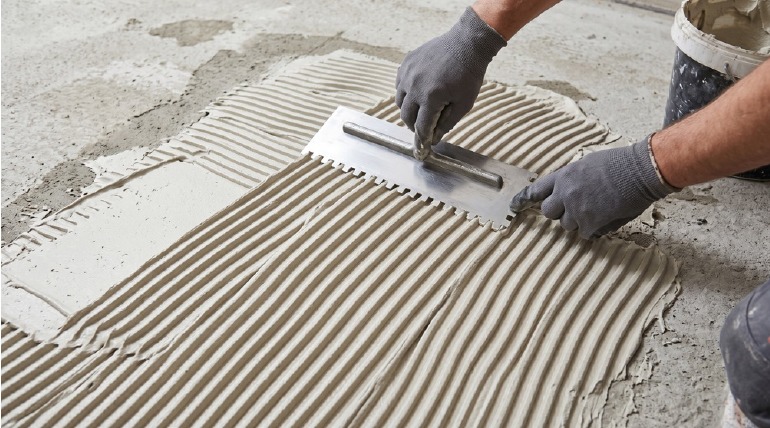
Traditional cement mortar often leaves air pockets beneath tiles because of its coarse consistency. These voids reduce support and create weak points that may eventually crack under load.
Tile adhesives are applied using a notched trowel, creating a consistent adhesive bed that provides uniform support across the entire tile surface.
Benefits include:
• Reduced hollow sounds
• Better load distribution
• Improved impact resistance
• Lower risk of cracking
Faster Installation and Higher Productivity
Construction schedules today are tighter than ever. Contractors require installation systems that improve productivity without compromising quality.
Tile adhesives offer several advantages over traditional cement mortar.
No Water Curing Required
Conventional cement installations generally require water curing for several days to minimise shrinkage and improve strength.
Tile adhesives eliminate this requirement.
Once applied correctly, they cure according to their designed formulation, helping projects move forward much faster.
Cleaner Application
Tile adhesive is supplied as a ready-to-mix product with consistent quality.
Compared to manually prepared cement mortar, it offers:
• Better workability
• Cleaner application
• Reduced material wastage
• Consistent performance
Lower Labour Requirement
Because installation becomes quicker and easier, contractors can complete larger tiled areas within shorter timeframes while maintaining consistent quality.
This improves overall construction efficiency and reduces labour costs.
Where Tile Adhesives Should Always Be Used
Although traditional mortar may still be seen on smaller projects, tile adhesives are strongly recommended for modern applications such as:
• Vitrified tiles
• Porcelain tiles
• Large-format tiles
• Glass mosaics
• Natural stone
• Marble
• Granite
• Bathroom walls
• Kitchen backsplashes
• Exterior cladding
• Commercial flooring
• High-traffic areas
Using the appropriate adhesive significantly improves long-term durability and reduces maintenance costs.
Choosing the Right Tile Adhesive
Not all tile adhesives are designed for the same application. Selecting the right product is essential for achieving optimum performance.
Consider the Tile Type
Different materials require different bonding characteristics.
For example:
• Ceramic tiles
• Vitrified tiles
• Porcelain tiles
• Glass mosaics
• Natural stone
Each material has unique absorption properties that influence adhesive selection.
Evaluate Tile Size
Large-format tiles place greater stress on the adhesive layer because of their size and weight.
These installations generally require higher-performance adhesives with enhanced tensile strength and flexibility.
Assess the Installation Area
Environmental conditions also influence adhesive selection.
Questions to consider include:
• Is the application indoors or outdoors?
• Will the area remain wet?
• Will it experience direct sunlight?
• Is heavy foot traffic expected?
Bathrooms, swimming pools, terraces, balconies, commercial buildings, and industrial facilities often require specialised tile adhesives designed for demanding service conditions.
Why Polymer-Modified Tile Adhesives Are Preferred
Among the various categories available, polymer-modified tile adhesives have become the preferred solution for professional installations.
The addition of polymers improves several critical performance characteristics, including:
• Higher bond strength
• Improved flexibility
• Better water resistance
• Greater crack resistance
• Longer service life
• Enhanced workability
These properties make polymer-modified adhesives suitable for demanding residential, commercial, and industrial applications where durability is essential.
HomeSure Tile Adhesives for Reliable Tile Installation
Choosing a quality tile adhesive is just as important as selecting quality tiles.
HomeSure offers a comprehensive range of tile adhesives developed to suit various tile types, formats, and installation conditions. Whether the project involves ceramic tiles, vitrified tiles, porcelain tiles, natural stone, or glass tiles, selecting the appropriate adhesive helps ensure reliable bonding, long-term durability, and consistent performance.
By combining proper surface preparation, correct application techniques, and the right adhesive, installers can minimise common issues such as debonding, hollow sounds, cracked grout joints, and tile failures.
Conclusion
The evolution of modern tiles has fundamentally changed the way they should be installed. Traditional sand-cement mortar, although effective for older porous tiles, no longer provides the bonding performance required for today’s dense vitrified, porcelain, and large-format tiles.
Tile adhesives offer significant advantages, including superior bonding strength, flexibility, faster installation, improved durability, and reduced maintenance. They help create long-lasting tiled surfaces capable of withstanding daily wear, moisture, temperature changes, and structural movement.
Selecting the right tile adhesive based on the tile material, size, and application environment is one of the most important decisions in any tiling project. When combined with proper installation practices, a high-quality tile adhesive ensures a durable, aesthetically pleasing finish that performs reliably for many years.
Also to read more about our product launches for Homesure TileEX Tile Adhesives read more –
Construction World – https://www.constructionworld.in/building-construction-products/walplast-launches-pu-epoxy-hybrid-tile-adhesive/93107
Contruction Times – https://constructiontimes.co.in/Walplast-launches-HomeSure-TileEx-EX-566-PU-tile-adhesive-6896
Bharat Herald – https://bharatherald.com/meeting-the-performance-demands-of-modern-tile-installations/