
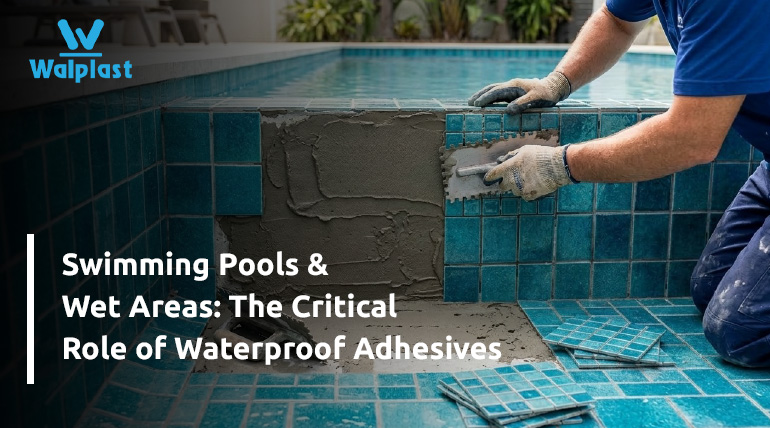
Swimming pools, spas, fountains, and other wet areas demand more than just attractive finishes. Unlike standard interior tiling, these environments endure constant exposure to water, pressure, and chemicals. In such high-stress conditions, the performance of Tile Adhesives becomes critical.
If you don’t choose the right adhesive system, tiles will become loose within months, this is true for both small bathroom projects and large swimming pool installations. Proper waterproof tiling isn’t just about how it looks; it also protects the structure, lasts a long time, and keeps you safe over time.
Choosing the right adhesive and grout ensures tiles stay firmly in place and perform well over time.
Key Insights
1. Swimming pools and wet zones face constant water immersion.
2. Pool tiling requires specialised materials.
3. Adhesive alone is not enough. System compatibility ensures long-term protection.
4. Epoxy grout improves durability and hygiene.
5. Correct installation methods are as critical as product selection.
6. Brand-backed system solutions reduce risk and improve reliability in demanding wet environments. Like HomeSure TileEx Ex- 44, TileEx EX 456 W, TileEx EX 344 W and HomeSure TileEx Ex – 55 tile adhesives and for grout, the perfect choice will be HomeSure TileEx Epoxy Grout.
The Submerged Challenge in Pools & Wet Areas
Swimming pools and permanently wet areas create some of the most demanding conditions for tile installations. Continuous exposure to water, chemicals, and structural movement places significant stress on tiles and bonding materials. Let us look at the key challenges that affect tile performance in such environments.
Submerged Condition:
Swimming pools remain submerged for long durations. Continuous water exposure can weaken the bond strength of ordinary adhesives, gradually causing tiles to loosen or detach over time.
Chemical exposure:
Pool water contains treatment chemicals such as chlorine and cleaning agents. These chemicals can attack conventional adhesive formulations, breaking down their bonding structure and leading to premature tile failure.
Hydrostatic pressure:
The weight and movement of water exert continuous pressure on tiled surfaces. If the adhesive is not designed for submerged environments, this pressure can eventually cause tiles to debond.
Temperature variation:
Pool water temperatures fluctuate due to weather conditions and usage patterns. These changes cause expansion and contraction in tiles and substrates, creating stress on the bonding layer.
Water ingress behind tiles:
If the bonding system is not designed for wet environments, moisture can penetrate behind tiles. This can weaken the substrate and eventually compromise the entire tile installation.
Limitations of conventional cement mortar:
Traditional cement mortar and low-grade adhesives are not designed for permanent immersion. Over time, constant water contact can weaken their bonding capacity and reduce overall durability.
Adhesive degradation over time:
Ordinary adhesives may soften, dissolve, or gradually lose grip under continuous water exposure, increasing the risk of tile failure.
Visible signs of tile system failure:
When unsuitable materials are used, common problems include tile debonding, hollow sounds behind tiles, surface cracks, grout deterioration, and damage beneath the tiled layer.
Due to these demanding conditions, swimming pool installations require materials engineered for submerged use.
High-performance tile adhesives designed for wet and submerged areas offer:
● Superior bond strength
● Capability to handle weathering
● Enhanced flexibility to accommodate movement
● Prevent or resistance to water-induced degradation
● Long-term durability and reliability
Using the right adhesive system is essential to ensure structural integrity, durable tile bonding, and long-lasting performance in swimming pools and wet areas.
Preventing Seepage: The Power of a Cohesive System
Waterproof tiling in pools should never rely on adhesive alone. A properly constructed system includes three essential components:
● Waterproofing membrane
● High-performance Tile Adhesive
● Chemical-resistant grout (such as epoxy grout)
Without a reliable waterproofing layer beneath the tiles, water can seep into the substrate. Over time, this may cause efflorescence, structural weakening, corrosion of reinforcement bars, and tile lifting.
Using a cohesive, compatible system ensures that all layers work together to prevent seepage. This approach not only protects the tiles but also safeguards the structural integrity of the entire installation.
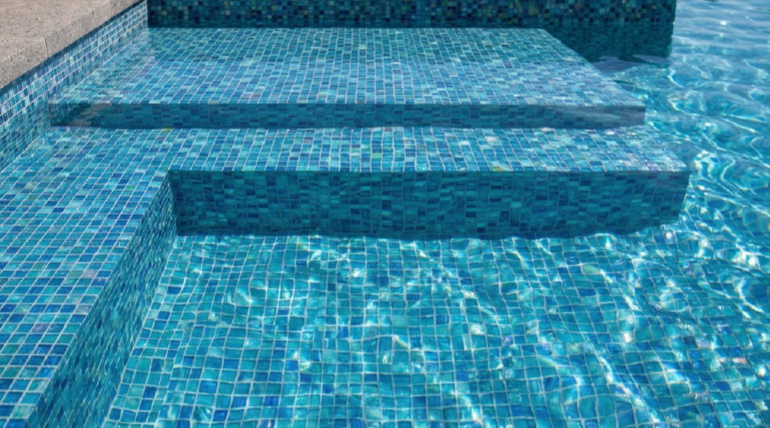
Challenges with Glass Mosaics
Glass mosaics are a popular choice in modern pool designs due to their vibrant colours and reflective finish. However, they come with specific installation challenges.
Because glass tiles are often translucent, adhesive colour and application quality become highly visible. Adhesive bleeding, shadowing, or uneven spreading can distort the appearance of the mosaic.
Additionally, the small size of mosaic tiles means that spreading must be even/ uniform, across the entire surface. Any gaps in the tile adhesive can compromise durability and aesthetics.
Best Practices for Installing Glass Tiles in Pools
Installing glass mosaics in submerged areas requires precision and the right materials. Key best practices include:
● Using white, high-bond Tile Adhesives to prevent discoloration or shadowing.
● Ensuring full adhesive coverage to avoid voids behind tiles.
● Selecting anti-slip adhesives for vertical pool walls.
● Maintaining recommended trowel thickness for proper adhesion.
● Pairing with epoxy grout for enhanced chemical resistance and stain protection.
Following these practices ensures that intricate mosaic designs remain secure, vibrant, and structurally sound for years.
The Walplast HomeSure Advantage
When it comes to waterproof tiling and swimming pool installations, the quality of materials plays a critical role in ensuring long-term performance. Walplast HomeSure offers specialised tile adhesive solutions (Like HomeSure TileEx Ex- 44, TileEx EX 456 W, TileEx EX 344 W and HomeSure TileEx Ex – 55 tile adhesives and for grout, the perfect choice will be HomeSure TileEx Epoxy Grout) engineered to perform in submerged and chemically exposed environments, along with high-performance grouting solutions designed for demanding wet areas.
These advanced formulations are designed to deliver:
● Superior bond strength even under continuous water exposure
● Excellent resistance to chlorine and common pool treatment chemicals
● Compatibility with HomeSure Epoxy Grout, ensuring strong, waterproof, and hygienic tile joints
● Enhanced flexibility to accommodate structural movement and thermal stress
● Long-term durability that protects both the tile surface and the underlying structure
By adopting a complete, system-based solution from Walplast HomeSure, combining high-performance tile adhesives with HomeSure Epoxy Grout, contractors, developers, and homeowners can achieve reliable tile bonding, durable joints, and reduced maintenance in demanding wet environments such as swimming pools and water features.
Because in environments where tiles remain constantly exposed to water, chemicals, and pressure, choosing the right installation system is not just a product decision — it is a long-term performance decision.