
The increasing popularity of large format tiles (LFTs)—commonly defined as tiles larger than 600 mm × 600 mm—has transformed modern architectural and interior design. Fewer grout joints, sleek aesthetics, and a monolithic appearance make them a preferred choice for residential, commercial, and façade applications.
However, the performance of large-format tiles depends significantly on the tile adhesive. Conventional adhesives designed for small tiles often fail when used with LFTs due to higher stresses, lower tile porosity, and differential movements. Both IS 15477:2019 (India) and EN 12004 (Europe / International reference) address these challenges by specifying enhanced performance requirements for tile adhesives intended for large tiles.
This article explains the key specialty properties required in tile adhesives for large format tiles, correlated with relevant clauses and classifications from these two standards.
Why Large Format Tiles Need Special Adhesives
Large format tiles differ fundamentally from conventional tiles in several ways:
• Low water absorption (especially vitrified/porcelain tiles)
• Higher dead load per tile
• Reduced grout joints, leading to stress concentration
• Thermal and structural movements transferred over large areas
• Risk of voids beneath tiles, causing debonding or cracking
To address these issues, standards require adhesives with higher bond strength, flexibility, slip resistance, and extended workability.
Specialty Requirements as per IS 15477:2019
IS 15477:2019 classifies cement-based tile adhesives into Type 1 to Type 5, with optional characteristics such as slip resistance (T) and deformability (S1/S2). For large format tiles, the following properties become essential.
1. High Tensile and Shear Adhesion Strength
Large tiles impose higher stresses due to self-weight and thermal movement. IS 15477 specifies minimum adhesion values tested under:
• Dry conditions
• Water immersion
• Heat ageing
Type 3, Type 4, and Type 5 adhesives are typically recommended for large format tiles due to their higher bond strength and polymer modification.
2. Polymer Modification
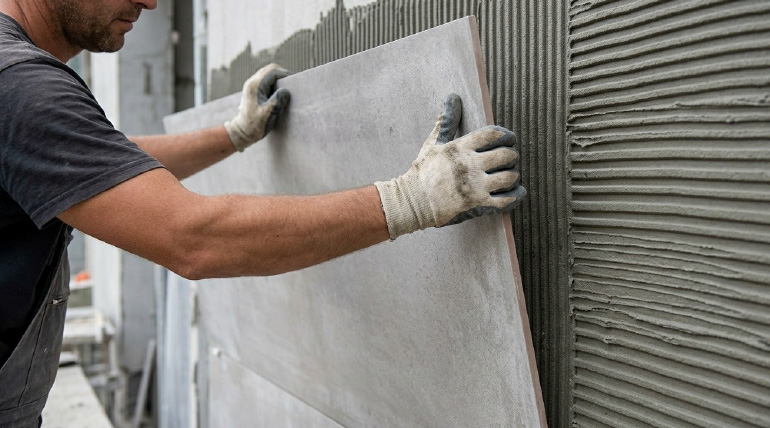
Large format tiles, especially vitrified and porcelain tiles, have very low water absorption. Adhesives must therefore rely on mechanical and chemical bonding, achieved through polymer-modified cementitious systems.
Polymer modification improves:
• Adhesion to low-porosity tiles
• Flexibility
• Impact resistance
• Durability in wet and thermal environments
IS 15477 explicitly recognizes deformable (S1) and highly deformable (S2) adhesives for such applications.
3. Slip Resistance (T)
When large tiles are installed on walls, gravity-induced slippage becomes a major risk. IS 15477 defines a slip-resistant adhesive (T) as one where tile movement does not exceed 0.5 mm.
For large format wall tiles, Type ‘T’ adhesives are mandatory to ensure:
• Accurate tile alignment
• Faster installation
• Reduced requirement for tile supports
This characteristic is especially important for vertical and façade installations.
4. Extended Open Time and Workability
Large format tiles require more time for positioning and leveling. IS 15477 includes adjustment/open time requirements to ensure that:
• Adhesive does not skin prematurely
• Full contact (≥90–95%) can be achieved
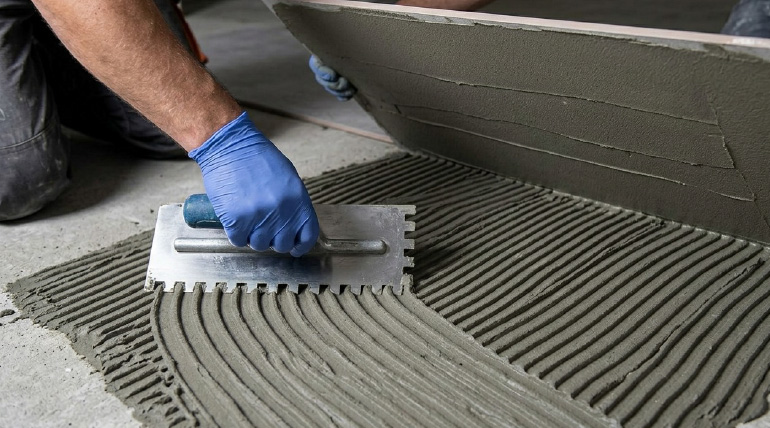
Extended open time helps installers apply back-buttering (buttering-and-floating technique), which is strongly recommended for tiles larger than 600 × 600 mm.
5. Deformability (S1 / S2)
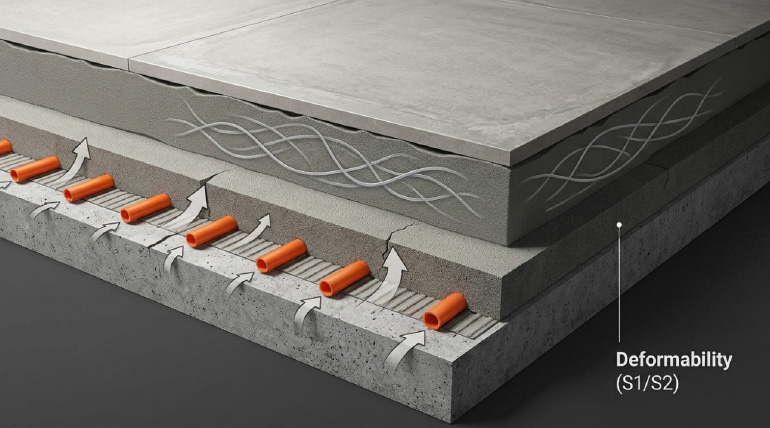
Deformability addresses the ability of the adhesive to accommodate differential movement between tile and substrate. IS 15477 references:
• S1 – Deformable adhesive
• S2 – Highly deformable adhesive
For large format tiles, especially on:
• Underfloor heating
• Exterior balconies and terraces
• Tile-on-tile applications
S1 or S2 adhesives are strongly recommended to prevent cracking and debonding.
Specialty Requirements as per EN 12004
EN 12004 (EN 12004 1:2017 and EN 12004 2:2017) is more explicit in classification and is widely regarded as the global benchmark.
Recommended Classification for Large Format Tiles
For tiles >600 × 600 mm, EN 12004 typically requires:
C2 TE S1 (or S2)
Where:
• C = Cementitious adhesive
• 2 = Improved performance
• T = Reduced slip
• E = Extended open time
• S1 / S2 = Deformable / Highly deformable
This classification is consistently cited in professional guidance for large porcelain and LFT installations.
Key EN 12004 Properties Relevant to LFTs
1. Improved Adhesion (C2)
Minimum tensile adhesion strength of ≥1.0 N/mm², ensuring suitability for large, dense tiles.
2. Extended Open Time (E)
Ensures that large tiles can be properly bedded without loss of adhesion due to surface skinning, especially in hot or windy conditions.
3. Reduced Slip (T)
Essential for vertical installations of heavy tiles, helping maintain precise positioning during curing.
4. Deformability (S1 / S2)
EN 12004 explicitly links S1 and S2 to large tiles, heated substrates, and movement-prone backgrounds.
• S1: ≥2.5 mm deformation
• S2: ≥5.0 mm deformation.
Practical Installation Implications
Both IS 15477 and EN 12004 emphasize that standards-compliant adhesives must be used alongside correct installation practices, including:
• Solid-bed fixing
• Back-buttering of tiles
• Proper trowel selection (≥10–12 mm notch for LFTs)
• Controlled substrate flatness
Using a compliant adhesive alone is not sufficient if installation guidelines are ignored.
The Walplast HomeSure Advantage
When it comes to large format tile installations, selecting the right adhesive is critical to ensuring long-term performance, safety, and durability. At Walplast, our HomeSure TileEx range is engineered to meet and exceed the demanding requirements defined by IS 15477:2019 and EN 12004 for large format tiles.
Our solutions are designed to deliver high bond strength, superior deformability, extended open time, and reliable performance across challenging applications, including exteriors, high-traffic areas, and low-porosity surfaces.
Key solutions include:
• HomeSure TileEx EX-44 External Expert – Ideal for exterior tile applications, offering durability under varying weather conditions.
• TileEx EX-344 W – Designed for enhanced performance in exterior environments with superior bonding and flexibility.
• EX-55 All Tile Expert – A versatile solution suitable for a wide range of tile types and substrates.
• TileEx EX-456 W – A high-performance adhesive recommended for large format tiles, ensuring excellent deformability and stress resistance.
With a strong focus on quality, consistency, and on-site performance, Walplast continues to be a trusted partner for modern construction needs—delivering solutions that align with evolving design trends and global standards.
Conclusion
Large format tiles demand high-performance, polymer-modified, deformable, and slip-resistant adhesives. Standards such as IS 15477:2019 and EN 12004 clearly define these requirements to ensure durability, safety, and long-term performance.
In summary, tile adhesives for LFTs (>600 × 600 mm) must offer:
• High tensile and shear adhesion
• Polymer modification
• Reduced slip (T)
• Extended open time (E)
• Deformability (S1 or S2)
Selecting adhesives compliant with Type 3 / 4 / 5 (IS 15477) and C2TES1 or C2TES2 (EN 12004) is no longer optional—it is essential for modern large-format tile installations.