
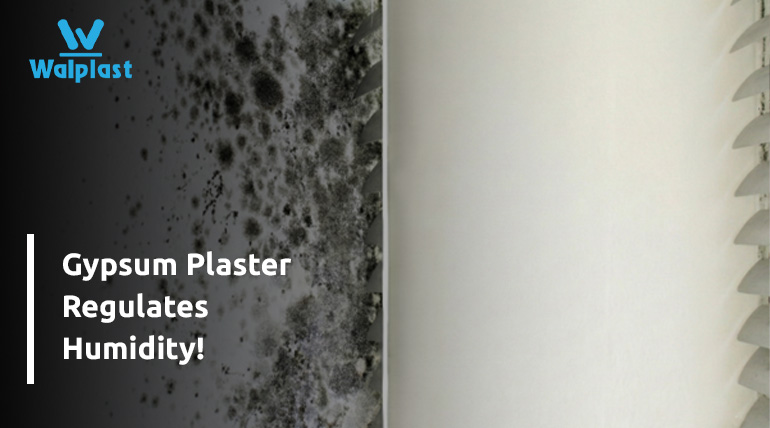
When we think about comfortable homes, we often focus on lighting, ventilation, or décor. However, one of the most influential elements in maintaining a healthy indoor environment is the material used on your walls.
Gypsum Plaster is increasingly becoming the preferred choice in modern construction. Far from being just a cosmetic finish, it is a high-performance material that actively regulates indoor humidity. Unlike conventional finishes, gypsum contributes to improved Indoor Air Quality (IAQ) by acting as a natural buffer against moisture.
Key Insights: Why Gypsum is the Future of Interiors
• Natural Moisture Buffer: Unlike cement, which traps moisture, gypsum’s hygroscopic nature allows it to absorb and release water vapor, maintaining ideal indoor humidity levels ($40\%–60\%$).
• Health-First Walls: By eliminating surface condensation, gypsum prevents the growth of mold, mildew, and dust mites—critical for families with respiratory sensitivities.
• Thermal & Energy Efficiency: Gypsum has significantly lower thermal conductivity ($0.26\text{ W/mK}$) compared to cement ($0.72\text{ W/mK}$), keeping rooms cooler and reducing AC energy consumption.
• Rapid Construction: Gypsum is a “dry” solution. It requires zero water curing and is paint-ready in just 4 days, compared to 15–21 days for cement plaster.
• GreenPro Certified Performance: Leading solutions like Walplast NOVA 125 are now CII GreenPro Ecolabel certified (2026), meeting the highest global standards for sustainable manufacturing and low-VOC emissions.
Moisture-Regulating Walls: How They Work
In construction, materials with hygroscopic properties allow water vapour to move through the surface rather than trapping it inside. Gypsum has the ability to absorb excess moisture from humid air and release it when the environment becomes dry.
Walplast NOVA 125 is naturally hygroscopic. Its micro-porous crystalline structure enables it to act as a moisture buffer. Instead of allowing condensation to settle or damp patches to form, gypsum balances the environment by regulating relative humidity, preventing that “sticky” feeling in summer and excessive dryness in winter.
The Science: More Than Just a Moisture Buffer
The secret to gypsum’s performance lies in its chemical composition: Calcium Sulphate Dihydrate ($CaSO_4 \cdot 2H_2O$).
1. Natural Humidity Regulation
Gypsum contains chemically bound water molecules. When indoor humidity rises, the crystalline framework temporarily stores excess vapor. When the air dries out, it gradually releases this moisture back into the atmosphere—acting like a natural, electricity-free dehumidifier.
2. Sound Insulation
Gypsum plaster helps improve indoor acoustic comfort by reducing the transmission of sound through walls. Its dense crystalline structure helps absorb and dampen noise, making interiors quieter and more comfortable, especially in residential apartments, offices and commercial buildings.
3. Thermal Insulation
Gypsum has a lower thermal conductivity than cement. This helps maintain stable indoor temperatures, reducing the load on your AC and lowering energy bills.
Cement Plaster vs. Gypsum Plaster: The Comparison
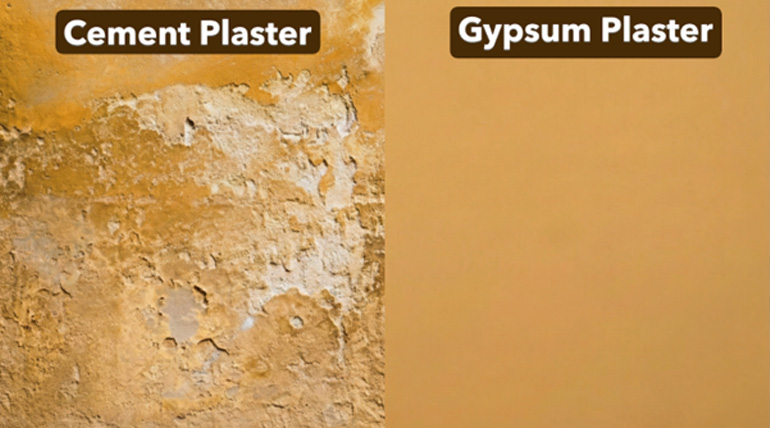
Parameter | Cement Plaster | Gypsum Plaster (NOVA 125) |
Moisture Behavior | Dense; traps moisture | Allows moisture exchange |
Curing Process | 7–10 days of water curing | Zero water curing required |
Thermal Property | High conductivity (Hotter) | Natural Insulator (Stay cooler) |
Mold Risk | Higher risk due to retention | Mold-resistant; prevents dampness |
Finish | Rough; requires POP | Mirror-smooth; direct-to-paint |
Why Moisture-Regulating Walls Are the Future
In the past, walls were expected only to support the structure. Today, they are expected to contribute to comfort, safety, and durability.
1. A Healthier Home Environment: Walls that regulate moisture help prevent mold and dust mites from developing, improving indoor air quality.
2. Natural Temperature Control: Gypsum acts like a layer of insulation. It doesn’t let heat from the outside enter easily, kee
3. Ping your rooms naturally cooler in the summer and warmer in the winter.
4. Built-in Fire Safety: The water trapped in the gypsum plaster acts as a natural fire shield, giving families extra time to escape.
5. Lightweight for Stronger Buildings: Gypsum plaster is significantly lighter than cement. Because it puts less weight (dead load) on the building’s structure, it is ideal for modern high-rise apartments and is more earthquake-resilient.
6. Fewer Repairs, More Savings: By reducing moisture-related damage, gypsum helps maintain paint finishes for longer without bubbling or peeling.
7. Better for the Planet: By eliminating the need for weeks of water curing, gypsum is the responsible, eco-friendly choice.
The NOVA 125 Advantage: GreenPro Certified
In 2026, the HomeSure GypEx range, including NOVA 125, received the prestigious GreenPro Ecolabel certification (CII-Green Products and Services Council). This recognizes our commitment to:
• Sustainable Sourcing: Responsible raw material evaluation.
• Eco-Friendly Manufacturing: Lower carbon footprint and reduced water consumption.
• LEED Compliance: Helping developers and homeowners achieve green building certifications.
Healthy Home Checklist
• Is your home free from damp “musty” smells?
• Is your interior paint free from bubbling and peeling?
• Do you have a smooth, crack-free finish on your walls?
• Is your home using sustainable, GreenPro-certified materials?
If you missed any of these, it’s time to upgrade.
Quick Recommendation: Use Gypsum Plaster When:
• You want fast project completion.
• You need a mirror-smooth finish without extra putty.
• You are working on internal walls & ceilings.
• You want to save curing water and labour costs.
Upgrade to a smarter interior finishing solution.
Contact a Walplast expert today to request a sample of NOVA 125 or locate a dealer near you.