
Modern construction relies heavily on tile adhesives not just for aesthetics, but for durability, safety, and long-term performance. As urbanisation accelerates and renovation activity rises, the global tile adhesive market is projected to grow at over 7% annually over the next decade.
With traditional cement–sand mortar gradually giving way to advanced adhesive systems, understanding the science behind tile adhesives has become more important than ever.
Studies show that nearly 30% of post-installation tile failures occur due to poor bonding, reinforcing the need for the right adhesive selection and correct application.
Key Insights
- Tile adhesives work through a combination of chemical bonding and mechanical interlocking.
- Polymer modification enhances flexibility, adhesion strength, and water resistance.
- Product formulation and correct application are equally critical for long-term performance.
- Compared to traditional mortar, modern tile adhesives offer superior durability and reduced failure risk.
- Advanced formulations also support sustainability through longer life cycles and reduced material wastage.
How Does Tile Adhesive Work — and Why Is It Better Than Mortar?
Tile adhesive is a ready-to-use or mixable bonding compound used to fix tiles onto substrates such as concrete, cement boards, or even existing tiles.
Unlike traditional cement–sand mortar, which relies mainly on thickness and pressure to hold tiles in place, modern tile adhesives are engineered for consistency, flexibility, and controlled curing. Mortar can shrink unevenly, retain moisture, or crack over time—leading to tile detachment.
Tile adhesives, on the other hand, combine cement, polymers, fillers, and performance additives to form a strong yet flexible bond that performs reliably even under temperature changes and moisture exposure.
Why Do Tile Adhesives Work So Effectively?
- Mechanical Interlocking
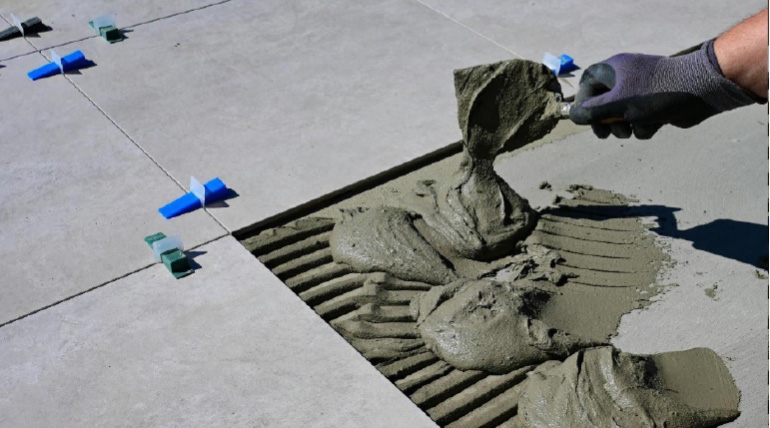
Tiles and substrates contain microscopic pores and surface irregularities invisible to the naked eye. When adhesive is applied, it penetrates these micro-gaps and hardens, creating a mechanical lock. The strength of this bond depends on surface cleanliness, adhesive thickness, and proper application.
- Chemical Bonding Through Polymers
Polymer-modified adhesives form elastic networks within the cement matrix. These polymers enhance:
- Adhesion to low-porosity tiles
- Flexibility under stress
- water resistance
This is why modern tile adhesives perform exceptionally well in wet areas, temperature fluctuations, and high-traffic zones.
What Makes Tile Adhesives Durable?
Durability is not just about strength—it’s about performance over time. Tile adhesives regulate moisture movement and reduce internal stress. Unlike traditional mortar, which may shrink unevenly, adhesives maintain structural integrity, preventing tile debonding and surface failures.
Key Factors That Affect Tile Adhesive Performance
- Surface Preparation
Clean, dry, and dust-free surfaces are essential. Poor preparation remains one of the leading causes of tile failure.
- Choosing the Right Adhesive
Different tiles require different adhesives. Large-format tiles, vitrified tiles, and natural stones need higher bonding strength and flexibility.
- Correct Mixing and Application
Incorrect water ratios or uneven troweling can weaken bonding. Uniform thickness and proper coverage are crucial.
- Environmental Conditions
Temperature and humidity influence curing time and bond strength. Extreme conditions require controlled application techniques.
Trusted Tile Adhesive Solutions
Brands like Walplast offer high-performance tile adhesive solutions designed to meet diverse tile types, substrates, and site conditions. Each product in the TileEx range is engineered for specific performance needs—whether it’s everyday ceramic tile installations or demanding stone and exterior applications.
Solutions such as EX-11 Ceramic Expert, EX-22 Vitrified Expert, EX-33 Stone & Glass Expert, EX-G33 Vitrified & Stone Expert, EX-44 External Expert, and EX-55 All Tile Expert are known for their strong bonding strength, durability, and consistent performance across varied environments.
Together, these solutions deliver the “Power of 4 Aces”—exceptional adhesion, easy application, reliable accessibility, and superior aqua safety—making the TileEx range a dependable choice for long-lasting and high-quality tiling outcomes.
Final Thoughts
Tile adhesive is more than a construction material—it is a science-driven solution that ensures durability, safety, and long-lasting aesthetics. By combining chemical bonding, mechanical grip, and advanced polymer technology, modern adhesives outperform traditional mortar systems.
Understanding this science helps in selecting the right product and ensures that tiled surfaces remain strong, secure, and visually appealing for years to come.